Where It All Began
First Generation | G1
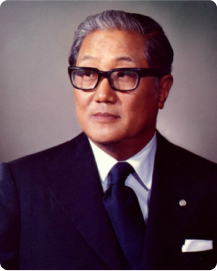
Keiichi (“Kay”) Sugahara was born in Seattle in 1909, the second of five children of Japanese immigrants. The family later settled in Los Angeles where Kay’s father, a descendant of the samurai warrior class, worked as a storekeeper until his early death. Orphaned at the tender age of 12, Kay moved into a Methodist mission dormitory, where he dreamed big dreams and worked hard to realize them. He stacked oranges at a fruit stand for fifteen dollars a week to help support his siblings while enrolled at the University of California at Los Angeles, graduating in 1932.
A year later, Kay and two partners founded a customs brokerage firm to clear goods through customs for Japanese-American merchants. During this period, Kay also acted as a consultant to shippers sending merchandise to Asia and was a trusted community leader, initiating new projects to revitalize the Little Tokyo area of Los Angeles.
World War II abruptly halted Kay’s momentum. After the attacks on Pearl Harbor in 1941, Kay, his wife, and their three young sons were interned by the United States government, initially housed in hastily converted horse stalls at the Santa Anita racetrack and later moved to the Granada War Relocation Center (known as Camp Amache) in Colorado. The business closed and the family lost everything, save for the few items they could carry in a couple of suitcases.
Despite these harsh and unjust circumstances, Kay remained a proud American patriot with a strong work ethic and determination to rebuild for his family. He supported the United States during World War II by joining the Office of Strategic Services (“OSS” – the predecessor of the Central Intelligence Agency) where, among other things, he disseminated anti-war propaganda in India.
After the war, Kay relocated his family to New York, where he continued his intelligence work and explored an entirely new array of east-coast opportunities. During this period, Kay became a major player in U.S.-Japan relations and helped lead the effort to reestablish Japan as a strong American ally and trading partner. His many accomplishments included bringing Yukio Ozaki, former Mayor of Tokyo, back to Washington, D.C. — home to the famous blossoming cherry trees that Mayor Ozaki had presented as a gift from Japan to the United States decades earlier.
By the mid-1950s, Kay had cemented his status as a prominent member of the Japanese-American cultural and business communities on a national level. Add that he advised US / Japanese leaders? Ask KG/Byron
The Rise of Fairfield-Maxwell
Second Generation | G2
In May of 1957, while continuing to forge U.S.-Japan relations, Kay worked with the largest fishery in Japan to convert its operations from coal to oil. In the process, Fairfield-Maxwell was born: a business that could broker sales between Mobil Oil and unaffiliated Japanese-owned refineries at wholesale rates. This was an industry first.
The establishment of Fairfield-Maxwell was a perfect example of Kay’s philosophy of creative risk taking, spotting hidden opportunities and connections that he could turn into successful endeavors. It has since also become a prime illustration of the business’s relationship-driven approach; Fairfield-Maxwell still partners with that same fishing company today.
Kay soon saw similar opportunities in other industries, and Fairfield-Maxwell began its expansion. It was around this time that the second generation of Sugaharas — Kaytaro (“KG”), Bryan, and Byron — joined the fold, each contributing in their own ways to the growth and transformation of the business.
First, Fairfield-Maxwell expanded into the Maritime space, where it built, sold, and leased tankers and cargo ships, beginning with the launch of the Marion in 1960.
Fairfield-Maxwell continued its diversification in 1974 with the acquisition of a U.K.-based seismic survey business and a seismic data processing business in Colorado. After merging the two companies, KG saw that this new entity, known today as Fairfield Geotechnologies, could become greater than the sum of its parts. He shifted the strategic focus from fulfilling service contracts for outside clients to gathering proprietary data—a much more profitabile activity, as the data could be licensed again and again. Fairfield Geo now owns the largest contiguous database for the Gulf of Mexico’s seismic shelf.
The Oil Crisis of the late 1970s threatened disaster for Fairfield Maxwell: they were committed to building an oil tanker, a huge expense with little hope for near-term returns. Facing this looming calamity, Byron, like his father, saw opportunity. He and KG had already built Reefer Express Lines, a business that revolutionized shipping by creating multi-purpose carrier ships, thereby minimizing the time when the ships would sail without paid cargo. Knowing that the US wanted to lessen its trade deficit with Japan, and that car carriers and refrigerated ships had some key features in common, he came up with the Sunbelt Dixie: a first-of-its-kind refrigerated car carrier. In 1978, Fairfield-Maxwell launched Great American Lines to operate the unique new ship, leveraging its relationships to win contracts to bring Toyota vehicles to the U.S. and return to Japan with Florida grapefruit. This award-winning business continues to operate to this day.
Concurrently, while managing Fairfield Maxwell’s European customers, Bryan formed a relationship with an individual who was looking to start a venture focused on tank containers. Bryan capitalized on Fairfield-Maxwell’s knowledge, experience, and contacts in the maritime space to create the partnership that later became Fairfield Tank Container.
By utilizing each of the Sugaharas’ unique strengths, Fairfield-Maxwell flourished.
In 1979, seeing that each of his sons had demonstrated the ability to effectively collaborate and make use of his individual aptitudes, Kay officially handed over the Fairfield-Maxwell reins to the next generation, appointing his eldest son KG as President.
Under KG’s leadership, Fairfield-Maxwell experienced significant growth in the oil & gas services industry, and in 1996, expanded into the chemical tanker shipping business. Fairfield Chemical Carriers (FCC) grew into one of the leading operators of stainless-steel chemical tankers in the world. Indeed, it became so successful that its projected growth exceeded Fairfield-Maxwell's capacity to fund it prudently while also managing its other businesses. Therefore, the Sugahara family made the difficult decision to seek a buyer that would allow FCC to operate with the same exacting standards and care for its employees as Fairfield-Maxwell did. Happily, MOL fit the criteria, and under its new ownership, FCC is set to thrive.
Fairfield-Maxwell 2.0
Third Generation | G3
In 2013, Fairfield-Maxwell broadened its focus beyond Maritime and Oil & Gas with the acquisition of SpeedPro Imaging, a provider of wide format imaging, opening the door to a more industry-agnostic partnership approach. Today, Fairfield-Maxwell continues to actively pursue opportunities in new industry verticals in addition to leveraging its deep experience in the company’s existing businesses.
Byron Sugahara, Kay’s middle son, became Chairman of the Board of Fairfield in 2017, where he remains today.
Byron’s son, Christopher Sugahara, has spent two decades at the firm, gaining experience through a broad variety of roles, both internally and across the portfolio. Today, Chris is Executive Vice President and Chief Investment Officer of Fairfield-Maxwell.
Chris saw that, in order to remain a world-class family-owned enterprise, Fairfield-Maxwell needs to be run with the utmost professionalism yet still retain the character of the Sugahara family. He and the rest of G3 have satisfied these twin aims through improved governance, shareholder focus, and the creation of a diverse corporate board. While Chris’s siblings and cousins are not involved in the day-to-day business operations, they take their ownership roles seriously, actively participating in the Sugahara Family Owners Group and Board. With varying perspectives from their own areas of expertise, together they have created Mission, Vision, and Values statements that integrate the principles and wisdom of prior generations, including creative risk-taking, innovation, and cultivating relationships.
It is through this mission and vision and these values that the business preserves its history and traditions while continuing to reach new levels of growth and excellence.
As the years go on and the generations become further removed from the firm’s founder, the Sugaharas thoughtfully engage with the firm not simply because of familial expectation but out of the genuine desire to be the keepers of something they believe in, and to help it grow. This sense of stewardship allows not only for a strong, cohesive owners group, but also for more diversity in thought and resources.
In short, it primes Fairfield-Maxwell for continued success.
Fourth Generation | G4
Coming Soon…